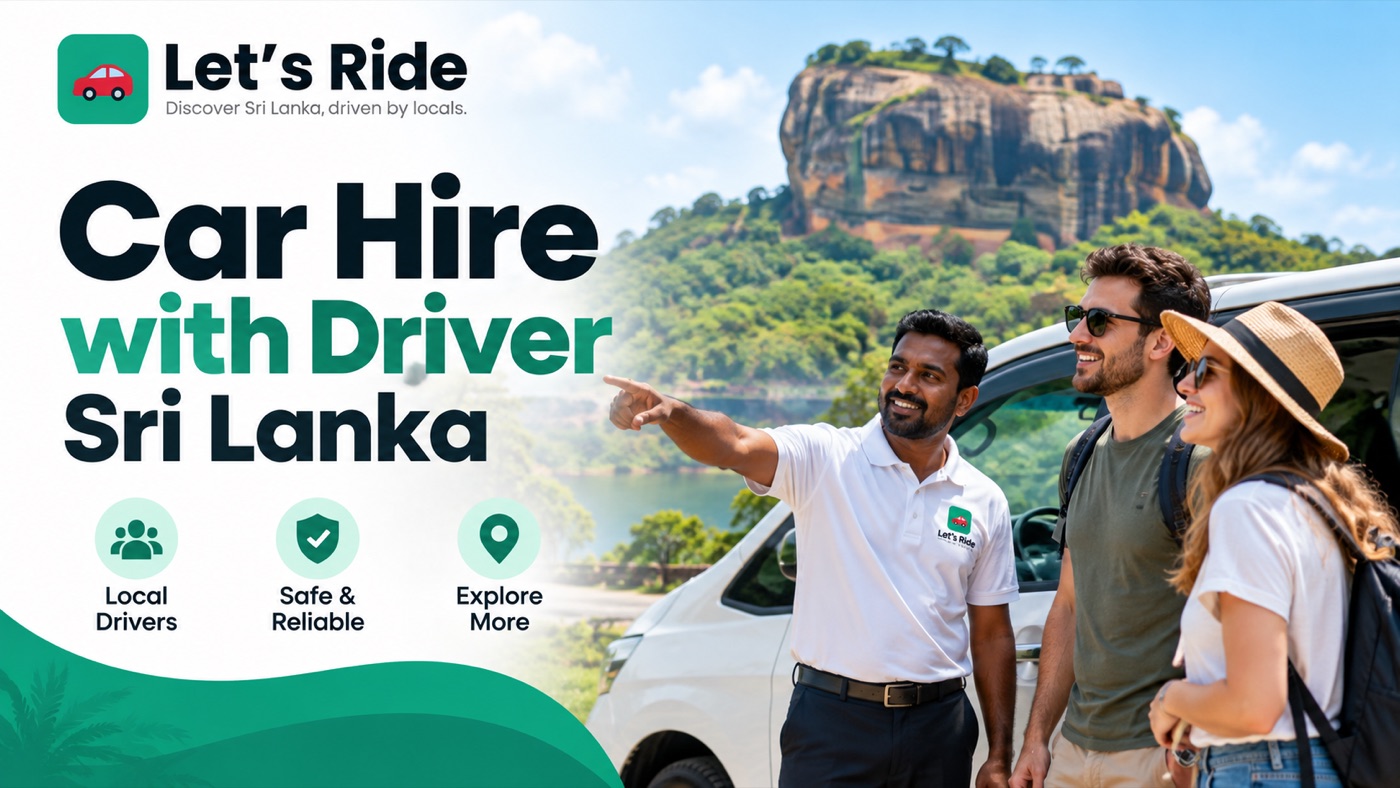
Hiring a car with a driver is the most common way visitors get around Sri Lanka, and for good reason. Roads here are slower than a map suggests, signage is inconsistent, and driving yourself on unfamiliar roads eats the time you came to spend somewhere else.
This guide covers what it costs, what is included, what the law expects of your driver, and how to check a driver is properly registered before you hand over any money.
What “car hire with driver” actually means here
It is not car rental, and it is not a taxi.
You will see the same thing called a few different names. Car hire with driver, private driver, and car and driver hire all describe the same arrangement, and Sri Lankan operators use them interchangeably. Locally you may also see outstation taxi, which simply means a trip out of town rather than a short hop across a city.
You are hiring a vehicle and the person who drives it, usually for a full day or for the length of your trip. The driver stays with you. They take you between towns, wait while you visit places, and often suggest where to stop.
Three things people commonly confuse:
Car rental means you drive. You need an International Driving Permit plus a Sri Lankan recognition permit, and you take on the traffic yourself.
Taxis and ride apps work well inside cities and for short hops. They are not designed for a week of touring.
Car hire with driver covers the middle ground, which is where most itineraries sit. Airport to hotel, then a loop through the hill country, then down to the coast.
What it costs
Prices depend on four things:
- The vehicle. A car for two costs less than a van for eight.
- How many days. Longer trips usually get a better daily rate.
- Distance. A day around Kandy is not the same as Colombo to Jaffna.
- Air conditioning. Usually included in the quoted price, but confirm it.
As a planning figure, budget roughly 60 to 100 US dollars a day for a car or SUV, and up to around 130 a day for a large van. That is deliberately on the safe side: rates move, and tolls or extras get added on the day, so it is better to budget a little high than to be caught short.
That gap is worth understanding. A quoted rate is one company’s price. It tells you what they want to charge, not what the trip is worth. This is the reason bidding platforms exist: when several owners quote on the same trip, you see the range rather than one number.
What is included, and what is not
This is where most misunderstandings happen, so be specific when you agree terms.
Usually included
- The vehicle and the driver
- Fuel
- The driver’s own wages
Usually not included
- Entrance tickets to sites
- Your own meals
- Parking and some highway tolls, though many drivers absorb these
- The driver’s meals on multi day trips
- The driver’s accommodation on multi day trips
- A tip
Those last three surprise almost every first time visitor, so they get their own sections below.
The driver’s meals and accommodation
On any trip with an overnight stay, the convention in Sri Lanka is that the traveller covers the driver’s food and a bed.
It sounds awkward if you have not met it before. In practice it is routine and inexpensive. Most hotels and guesthouses that take tourists keep basic driver rooms, either free with your booking or for a small charge, because they expect drivers to arrive. Meals are local prices, not restaurant prices.
Budget a small amount per day and agree it in advance. The mistake is not paying it. The mistake is not discussing it, then having the conversation on day three in a hotel car park.
If a quoted price seems unusually low, ask whether it assumes you are covering these. That is often the difference.
Tipping
Tipping is expected but not rigid. Sri Lanka is not a country where a fixed percentage is enforced.
For a driver you have had for several days, a common approach is a few dollars per day, handed over at the end rather than daily. If a driver has gone out of their way, waited for hours while you climbed something, or rescued a day when plans fell apart, more is normal and appreciated.
Tip in Sri Lankan rupees rather than foreign notes. Small denominations of foreign currency are difficult to change here and lose value in the process.
The legal side: SLTDA registration
This is the part almost nobody explains properly, and it is the part that protects you.
Sri Lanka Tourism Development Authority, usually shortened to SLTDA, is the government body that oversees tourism businesses. Drivers who carry tourists are expected to be registered with it. The government has moved to make that registration compulsory rather than optional.
A registered tourist driver has:
- A registration number, in a format like SLTDA/ATD/00001
- A photo ID card issued by SLTDA
- Completed the required short training course
How to check a driver yourself
Sri Lanka Tourism publishes a public directory of authorised tourist drivers on its official website: srilanka.travel/authorized-tourist-drivers. You can search it by the driver’s name, their registration number, or their association.
That means you do not have to take anyone’s word for it, including ours. Ask your driver for their SLTDA registration number, then search for it. It takes a minute and it is the single most useful check a visitor can make.
If someone cannot produce a number, that is not automatically sinister. Plenty of perfectly good drivers work locally without tourist registration. But for a multi day trip with a stranger, in a country you do not know, a verifiable registration is a reasonable thing to want.
Where Let’s Ride sits in this, honestly
We check identity and vehicles. Every vehicle owner registers with a Sri Lankan National Identity Card, and every vehicle is reviewed by hand before it can be offered, including photographs where the number plate must be readable and match the registered number.
We do not currently verify SLTDA registration. We would rather tell you that than let you assume otherwise.
You can still use Let’s Ride to find one, and it takes one sentence. When you post your trip, write “SLTDA registered driver preferred, please include your registration number” in the special requirements box. Vehicle owners see that before they bid, and the ones who are registered will put their number in the note attached to their offer.
You then have the number in writing, before you have agreed to anything, and you can check it against the official directory. Owners who ignore the request have told you something too.
It is a fair thing to ask and a registered driver will not mind being asked.
A driver is not a guide
Worth knowing before you arrive, because it disappoints people who did not expect it.
Guiding inside archaeological sites, national parks and museums is a separate qualification in Sri Lanka, with its own training and licence. A tourist driver licence does not cover it.
Your driver will usually know an enormous amount about the country, tell you where to eat, and steer you away from tourist traps. They will not normally walk you around Sigiriya explaining the frescoes. At major sites you may want to hire a site guide at the entrance, which is inexpensive.
Some drivers do hold a chauffeur guide qualification, which is a longer course and does allow guiding. If that matters to you, ask specifically, because it is a different licence and not everyone has it.
Insurance and safety
Ask two questions before you book:
Is the vehicle insured to carry paying passengers? Private insurance and hire insurance are different things.
Who drives if the driver is unwell? On a long tour this genuinely comes up. A good answer is that they have a colleague who can step in.
Beyond that, ordinary sense applies. Share your itinerary with somebody at home. Keep your driver’s phone number saved. Sri Lanka is a straightforward place to travel and serious problems are rare, but a stranger driving you for a week is worth five minutes of due diligence.
How to choose between drivers
If you are comparing several offers, price is the least useful thing to compare first.
Read what they wrote. A driver who mentions something specific about your route has read your plans. One who sends a bare price has not.
Look at the vehicle photos. Not a stock image of the model, the actual vehicle. You may spend forty hours in it.
Check the extra kilometre rate. Some quotes include a per kilometre charge for distance beyond your planned route. If you are likely to add detours, a slightly higher price with no extra rate can work out cheaper.
Ask about their English. Or German, or French. Comfortable conversation changes a long drive completely.
Booking without paying a middleman
There are three usual routes.
Through a hotel or agency. Easy, and you pay a margin for it.
Directly with a private driver you found online. Cheaper, but you are trusting reviews on a page the driver controls.
Through a marketplace. You describe the trip and owners compete for it, which surfaces the real range rather than one company’s rate.
Let’s Ride works the third way. Posting a trip is free, you see the offers side by side, and you pay the driver directly. We take no booking fee and no commission, and we never handle your money. If anybody asks you to pay us, or asks for payment on a driver’s behalf, that is not us.
Common mistakes
Booking day by day. Multi day trips almost always cost less per day.
Only comparing the headline price. Extra kilometre rates, the driver’s provisions and the vehicle’s condition all change what you actually pay and experience.
Assuming the map’s timings. Sri Lankan roads are slow. A hundred kilometres can take three hours. Build in more time than you think.
Leaving payment vague. Agree the amount, the currency and when it is handed over before you set off.
Expecting a guide. Discussed above, and the most common disappointment.
Getting started
Post your trip with the route and dates, wait for offers, compare them, and pick the one you like. It is free, and you are not committed to anything until you accept an offer. Our help centre walks through posting a trip and comparing the bids you get back.
Before you do, ask for the SLTDA registration number and check it on the official directory. It takes a minute, and it is the best minute you will spend on planning your transport.